

In recent weeks, France, like much of Europe, has faced record-breaking heat waves. One thing is clear: water is an essential resource for adapting our cities to new environmental conditions. Whether it’s drinking water, wastewater, groundwater, rivers, or seas, every drop counts in ensuring both the well-being of residents and the resilience of urban areas.
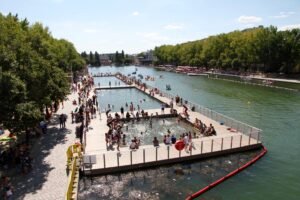
In this context, the reopening of swimming in the Seine in Paris is both a powerful symbol and a concrete example of urban adaptation. Banned since 1923 due to pollution, swimming has been possible again since 5 July 2025, thanks to an ambitious clean-up programme launched ahead of the Olympic Games and supported by the City of Paris. Beyond its symbolic value, this initiative addresses major climatic, social, and urban challenges.
Rethinking public space and social inclusion
Swimming in the Seine perfectly illustrates the ambition to rethink public spaces, restore natural urban ecosystems, and promote social equity. Providing clean, accessible, and refreshing places encourages well-being, social connection, and inclusion. This is especially important for children and families who remain in the city during summer: in the Île-de-France region, one million children do not leave for holidays each year. Opening the Seine to swimmers helps make the city more welcoming and enjoyable for everyone.
Following European examples
France is beginning to catch up with other European countries. In Switzerland, Germany, the Netherlands, Vienna, and Copenhagen, river swimming is already part of daily life. Inspired by Paris, other French cities such as Metz, Lille, and Limoges are also exploring ways to make their waterways accessible for swimming, reflecting a growing desire to reconnect urban populations with rivers.
Balancing leisure and logistic activities
The Seine is not only a recreational space—it is also a major logistics artery. Every year, over 10 million tonnes of goods pass through it. River transport, a low-carbon alternative to road transport, already removes 400,000 lorries from the roads and saves 90,000 tonnes of CO₂ annually. Opening rivers to new uses doesn’t mean pitting leisure against logistics; it means imagining smart, sustainable, and scalable ways for both to coexist. The Seine demonstrates how nature, mobility, and quality of life can flourish together when guided by a long-term urban vision.
Water at the heart of urban life
These initiatives show that cities can be reimagined with water and natural spaces at their core. Climate and social challenges can become opportunities: creating places for relaxation, social interaction, and respite while reducing carbon footprints and enhancing biodiversity.
The question now is what the future holds for our waterways. How can we continue to envision cities where water is no longer just a logistical or environmental concern, but also a source of well-being, inclusion, and social cohesion? By learning from European experiences and continuing efforts to clean and redevelop urban rivers, our cities have the potential to become more sustainable, resilient, and enjoyable places for everyone.
To what extent are your activities dependent on water resources ?
Let’s figure out together how the evolution of water resources can put your business model at risk and/or which opportunities your organisation can grasp in that matter.
➔ Contact us for an ESG risk assessment.